

Strategy
Why AI Initiatives Stall: 3 Organizational Gaps and How to Close Them
In our previous post, we shared a clear pattern from our recent workshop: many leaders identified leadership misalignment and organizational inertia as among the biggest barriers to successful AI adoption.
Organizations already have access to capable AI tools. The harder work is deciding where to apply them, establishing clear ownership, and building the systems to scale what works and deliver sustained business value.
Across our work at Telos Labs with companies in financial services, professional services, manufacturing, and other established industries, we have seen leadership inertia take several distinct forms, each with its own causes and each requiring a different response. Too often, conversations about “getting leadership buy-in” treat it as a single issue, when it is a multilayered challenge that must be unpacked before it can be addressed.
Three ways org charts kill AI projects
The strategic gap: no shared view of where AI creates value
We went through this at Telos Labs. Would AI replace all software engineering and product development? Unsurprisingly, our answer is no. But for a brief few-week period, it really seemed like the great job liquidation theory that OpenAI and Anthropic were putting forward could be plausible.
Then we dug in and embraced AI across our work, harnessing it for software engineering, product management, product design, and using LLMs across products like SaverLife and SimpleDocs. With understanding, we realized that AI presented an opportunity for us to double-down on our strategic and judgment-focused culture, as opposed to purely writing code.
What started as a threat became a unifying force, a promise to enable maximally productive work for our clients with great human ergonomics.
Most organizations can’t get started with AI because it’s a complex technology that can be used in many different ways. The explosion of options is paralyzing. The way through that complexity is to define the specific opportunity or risk AI presents for the business.
At Telos Labs, we worked with a consulting firm to explore how AI could search fragmented systems and identify the right talent for each engagement, reducing staffing time.
We identified an opportunity to redesign WhatsApp-based support and intake to reduce bottlenecks while improving conversion and client satisfaction. In both cases, the value came from connecting the workflow to a clear business metric.
In short, once the opportunities and the value at stake become clear for the organization, the strategy unfolds and the organization can use its own org chart to its advantage by operationalizing the thoughtful use of AI throughout the org.
But strategy comes first. And most organizations skip it, and not because they don’t care, but because nobody has given them a usable definition of what an AI strategy actually is.
An AI strategy is a set of choices that defines where the tool can create value in the business, who owns the outcome, and how tradeoffs will be made when priorities conflict.
This work can be led by someone inside the organization or supported by a partner like Telos Labs to guide the process. It does not require a six-month planning exercise. It starts with three questions: What problem are we solving? Who owns the business outcome? What evidence of progress should we expect to see?
Get the next one in your inbox
Sign up for our newsletter for practical advice on putting AI to work in your operations, plus a heads-up on upcoming working sessions.
The fluency gap: separating actual capability from hype
At the end of our recent workshop, only two-thirds of participants felt better equipped to evaluate AI claims without falling for hype.
When senior leaders can’t distinguish a real capability from a confident demo, they become dependent on vendors to define both the problem and the solution simultaneously. That’s a bad position to negotiate from. It tends to produce expensive commitments to platforms built for much larger organizations, followed by a long, painful process of trying to make the organization fit the tool rather than the other way around.
The fluency gap also makes it harder for leaders to push back internally. If you can’t describe specifically what a proposed AI solution does and doesn’t do, you can’t make a confident case for it to a skeptical CFO or a cautious general counsel.
Three things have helped our clients close this gap faster:
First, run a structured vendor evaluation session before any demo, where the leadership team agrees in advance on the questions they need answered and what a satisfactory answer looks like.
Second, bring in an outside advisor whose explicit job is to translate between what vendors claim and what the technology can actually do in your specific context.
Third, spend time with the people in your organization who are already using AI, even if informally. They’ve built the practical intuition your leadership team is missing, and that conversation is usually more grounding than any vendor presentation.
The ownership gap: support without authority
This one has two layers that almost always get conflated, and conflating them is one of the most reliable ways to stall a project.
The first is ownership of the tool rollout: who’s responsible for selecting a vendor, managing the implementation, and making sure the system is configured correctly. The second is ownership of the workflow outcome: who’s accountable for whether the process the AI is supposed to improve actually gets better, and by how much.
In most organizations, neither owner is clearly named. AI gets added to the agenda of five different teams simultaneously, and because it belongs to everyone, it belongs to no one. The technology team ends up responsible for the tool without being accountable for the business result. The operations leader is accountable for the result without having been involved in the tool decision. When the initiative stalls, there’s nobody to hold accountable because the two layers of ownership were never defined.
There’s a version of leadership support that’s real but not actionable: the CEO mentions AI in every all-hands, the annual strategy deck has an AI slide, and the leadership team has agreed in principle that AI is important. But nothing changes operationally because no one has been given the specific authority to make tradeoffs.
Someone has to decide the team will spend two weeks documenting a workflow before building anything. Someone has to tell a department head their process is going to change, and have the organizational standing to make it stick. Someone has to reject a vendor after a good demo because the fit wasn’t right. Without clarity here, support and authority remain two different things, and organizations need both.
AI does not create ambiguity. It reveals it.
Every company accumulates what I think of as organizational debt. This is different from the technology debt that engineering teams talk about, which refers to shortcuts taken in building software that create maintenance problems later. Organizational debt is the accumulation of unclear ownership, informal processes that work because specific people know how to do them, and decisions that live in someone’s head rather than in a documented policy.
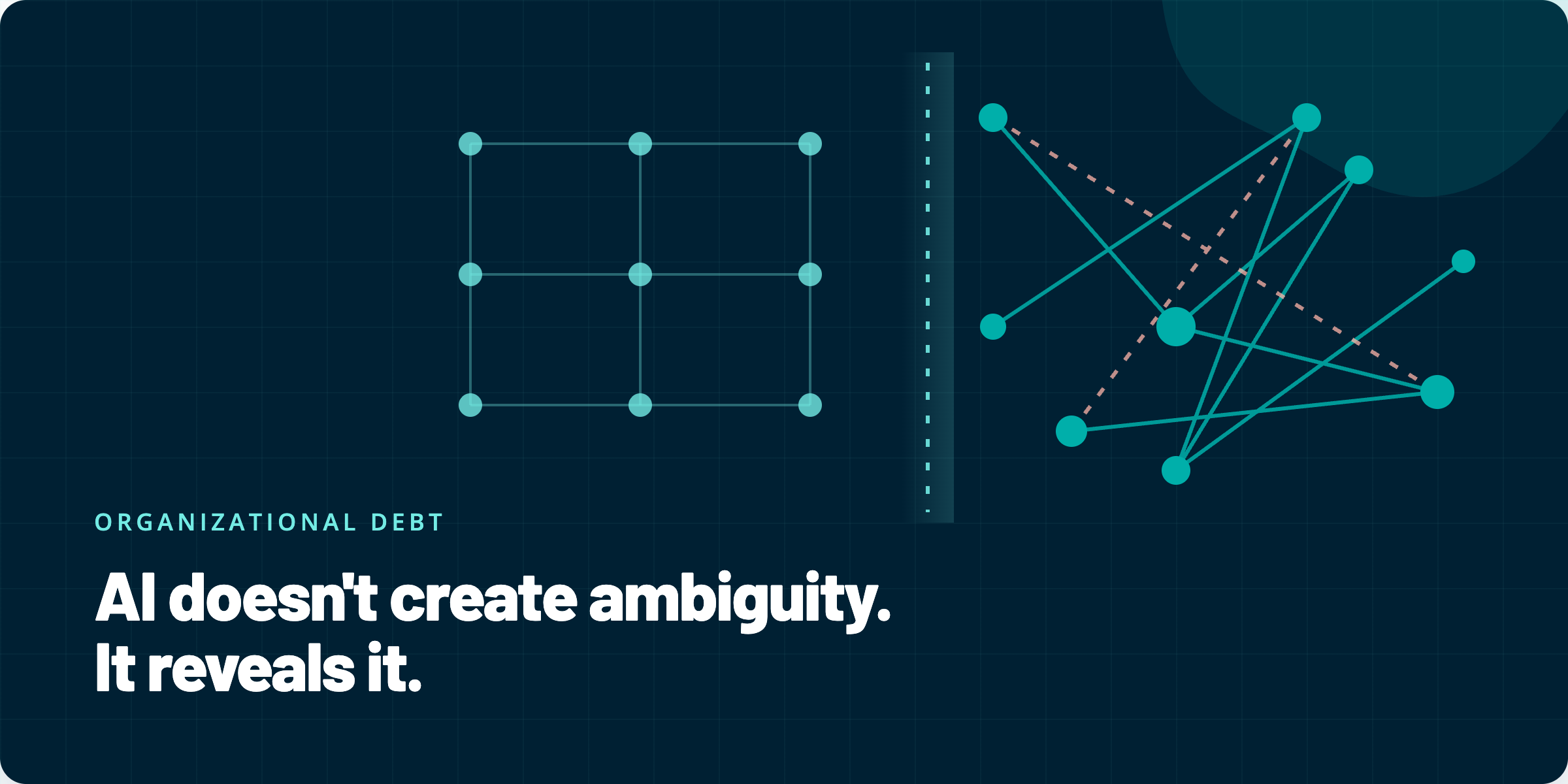
This is why the organizational debt problem and the three gaps above aren’t separate issues. The strategic gap persists because the rules for how AI decisions get made were never written down. The fluency gap persists because nobody has documented what good AI output looks like for your specific workflows. The ownership gap persists because the informal authority structures that run most organizations were never designed to handle cross-functional technology decisions. Organizational debt is the substrate all three gaps grow in. Clearing it is the prerequisite to all of the next steps below.
Three next steps for leadership
1. Name the owners before you name the vendors.
Most AI initiatives have sponsors but no owners. Go back to the two layers from the ownership gap: assign one person accountable for the tool rollout and one person accountable for the workflow outcome. These can be the same person in a smaller organization, but they need to be named explicitly and given the authority to make decisions without returning to committee.
This single action closes more organizational debt than any other. It forces clarity on who has the standing to reject a vendor, change a process, or tell a department head their workflow is going to look different in 90 days. Every subsequent decision has a clear owner. Vendors get evaluated by someone with a mandate instead of a group with opinions.
2. Build fluency before you build strategy.
The fluency gap and the strategic gap look like the same problem but they require different interventions in a specific order. Fluency comes first. Run a structured evaluation session where your leadership team agrees on the questions before any vendor walks in the door. Talk to the people in your organization already using AI informally. Get hands-on with the tools before you commit to a direction. This isn’t about becoming technical. It’s about being an informed enough buyer that the strategic conversation that follows is grounded in reality rather than demos.
Once the team is grounded, the strategy conversation becomes productive: what problem are we solving, who owns the outcome, and what does progress look like within a set time period. That sequence, fluency first and then strategy, is what lets the organization build a framework it can actually act on rather than a roadmap that stalls the moment a vendor underdelivers.
3. Run the org chart conversation before the vendor evaluation.
The strategic gap and the ownership gap share the same root cause: the organization never sat down and mapped out who has authority over what. Do this before any vendor evaluation begins. The questions are straightforward: who owns tool rollout, who owns workflow outcomes, who has authority to make tradeoffs, and what decisions require consensus versus a single call.
The conversation is uncomfortable because it surfaces ambiguity that informal structures have papered over for years. Organizational debt doesn’t disappear when you start an AI project. It surfaces, usually at the worst possible moment. Running this conversation first means the hard decisions that arrive during implementation have a structure for getting made rather than getting deferred back to the group indefinitely.
The outcome of this work is an AI project with a named owner, defined scope, and leadership team that has already agreed on how conflicts get resolved. This is the operating layer. Everything else, the vendor, the tool, the rollout, goes on top of it.
Not sure where your gaps are?
Book a discovery call and we'll pressure-test your strategy, fluency, and ownership before you talk to a single vendor.
Organizations fail when they treat AI adoption as a technology decision. The work that determines whether an AI initiative succeeds or stalls is organizational: getting clear on where AI creates value, building the fluency to evaluate it honestly, and naming the people with the authority to act. Get that layer right and the technology decisions get easier. Skip it and no vendor will save you.
Frequently asked questions
More posts in Strategy

Easy to Start, Hard to Stop: The Token Economics That Decide Whether an AI SaaS Survives
For an LLM-dependent SaaS, token economics are a survival question. How routing and evals move cost onto an axis you actually control.

Jul 16, 2026
Five Questions to Ask Before You Approve an AI Project
Before you sign off on an AI vendor, agency, or software purchase, five questions surface the cost risks the demo hides.
Jul 15, 2026

CPG Leaders Are Ready for AI. They Just Need a Clear Place to Start.
Nine CPG leaders on where to actually start with AI. The barrier isn't technology or budget, it's turning ambition into one workflow, one owner, and a clear first move.

Jun 30, 2026